
Most dental practices track production, collections, and new patient counts.
But there’s one metric that quietly drives all those outcomes—and often gets overlooked: Annual Patient Value (APV).
APV measures the average dollar value of care a patient receives in your practice over the course of a year. More importantly, it reflects how effectively your practice converts patient trust into comprehensive, appropriate care. Whether it’s measured intentionally or not, APV influences profitability, scheduling efficiency, team stress, and long-term sustainability.
Higher APV Isn’t About “Doing More”—It’s About Doing Better.
A higher APV doesn’t mean overtreatment. It means patients are receiving a broader mix of services that support their long-term oral and overall health. Practices with strong APV metrics tend to be effective in education, diagnosis, and follow-through—patients understand their conditions, accept treatment, and return consistently.
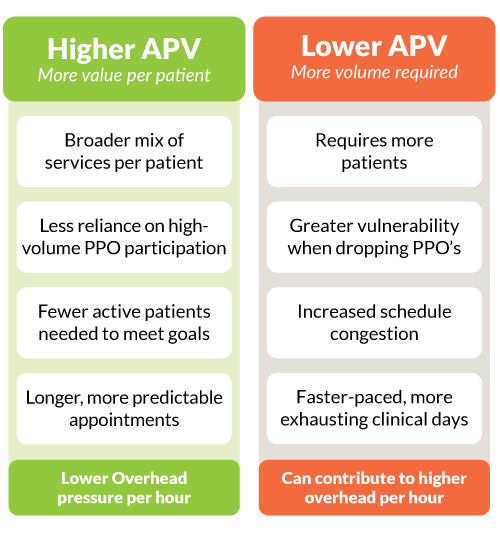
When APV is strong, fewer active patients are needed to meet production and collection goals. Appointments are longer and more predictable, and the schedule runs with less congestion and fewer “fill the day” pressures. The practice can be less dependent on high-volume PPO participation, and the per-hour overhead pressure is reduced. In these practices, growth feels intentional –not exhausting.
The Hidden Costs of Lower APV
Practices with lower APV often compensate by increasing volume. That typically means tighter schedules, faster clinical-paced days, and greater dependence on insurance participation to
maintain revenue.
Lower APV can lead to schedule congestion and shorter appointment times, faster-paced, more exhausting clinical days, and increased vulnerability to changes in insurance participation. This leads to higher overhead pressure due to inefficiencies and more stress without meaningfully better outcomes.
Simply put, when APV is low, growth often creates stress without delivering better outcomes for patients or the team.
How to Calculate Your Annual Patient Value
Understanding APV starts with knowing how to calculate it. Many practices find value in looking at APV from both production and collections perspectives to gain a clearer picture of performance and opportunities.
- APV by Production = Total Annual Gross Production ÷ Number of Active Patients
-
- This calculation shows the average amount of dentistry produced per patient each year.
2. APV by Production = Total Annual Gross Production ÷ Number of Active Patients
-
- This calculation reflects what the practice retains per patient annually.
Using both metrics allows you to compare clinical performance and financial effectiveness while identifying potential gaps between production
and collections.
Why APV Is a Strategic Metric
APV doesn’t just measure performance—it shapes strategy. Practices with strong APV have more flexibility in scheduling, staffing, and insurance participation. Practices with lower APV often feel forced into decisions they don’t want, such as adding more days, more providers, or more insurance plans to sustain growth. Improving APV is usually about refining systems: patient education, diagnosis consistency, scheduling alignment, and follow-through.
The Bottom Line
If your APV is lower than desired, growth often comes at the cost of stress, burnout, and inefficiency. When APV is strong, growth becomes more predictable, sustainable, and rewarding.
Knowing your Annual Patient Value—and understanding what drives it—is one of the most effective steps a practice can take toward
long-term health.
Your success is our success. Please reach out to us anytime.
Learn more, visit the Practice Support Team page, email us at PracticeSupportTeam@BurkhartDental.com, or call 1.800.665.5323.

Category: Practice Consulting
Back to Articles